 Add to Chrome
 Add to Firefox
 Add to Edge
PCMind-2.1-Kaiyuan-2B Technical Report
Dec 08, 2025
The rapid advancement of Large Language Models (LLMs) has resulted in a significant knowledge gap between the open-source community and industry, primarily because the latter relies on closed-source, high-quality data and training recipes. To address this, we introduce PCMind-2.1-Kaiyuan-2B, a fully open-source 2-billion-parameter model focused on improving training efficiency and effectiveness under resource constraints. Our methodology includes three key innovations: a Quantile Data Benchmarking method for systematically comparing heterogeneous open-source datasets and providing insights on data mixing strategies; a Strategic Selective Repetition scheme within a multi-phase paradigm to effectively leverage sparse, high-quality data; and a Multi-Domain Curriculum Training policy that orders samples by quality. Supported by a highly optimized data preprocessing pipeline and architectural modifications for FP16 stability, Kaiyuan-2B achieves performance competitive with state-of-the-art fully open-source models, demonstrating practical and scalable solutions for resource-limited pretraining. We release all assets (including model weights, data, and code) under Apache 2.0 license at https://huggingface.co/thu-pacman/PCMind-2.1-Kaiyuan-2B.

PanGu-$α$: Large-scale Autoregressive Pretrained Chinese Language Models with Auto-parallel Computation
Apr 26, 2021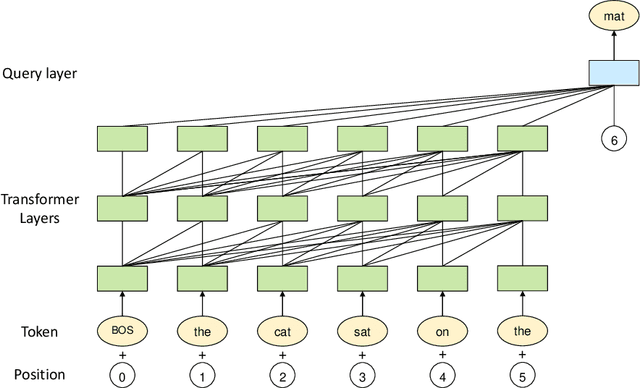
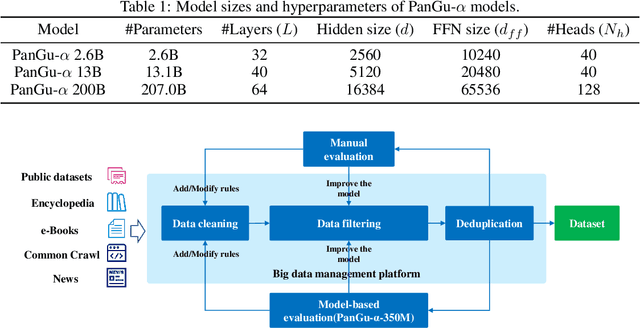
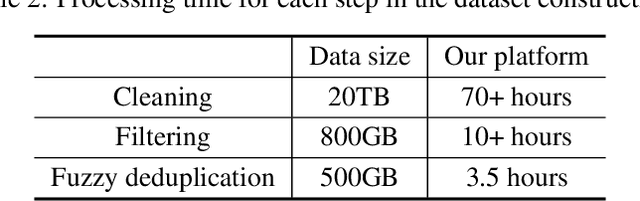
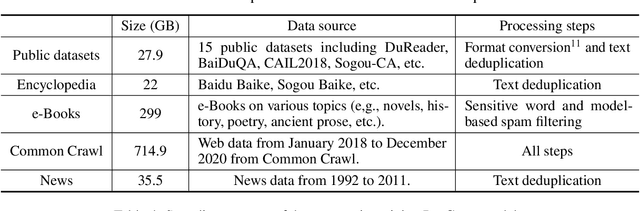
Large-scale Pretrained Language Models (PLMs) have become the new paradigm for Natural Language Processing (NLP). PLMs with hundreds of billions parameters such as GPT-3 have demonstrated strong performances on natural language understanding and generation with \textit{few-shot in-context} learning. In this work, we present our practice on training large-scale autoregressive language models named PanGu-$\alpha$, with up to 200 billion parameters. PanGu-$\alpha$ is developed under the MindSpore and trained on a cluster of 2048 Ascend 910 AI processors. The training parallelism strategy is implemented based on MindSpore Auto-parallel, which composes five parallelism dimensions to scale the training task to 2048 processors efficiently, including data parallelism, op-level model parallelism, pipeline model parallelism, optimizer model parallelism and rematerialization. To enhance the generalization ability of PanGu-$\alpha$, we collect 1.1TB high-quality Chinese data from a wide range of domains to pretrain the model. We empirically test the generation ability of PanGu-$\alpha$ in various scenarios including text summarization, question answering, dialogue generation, etc. Moreover, we investigate the effect of model scales on the few-shot performances across a broad range of Chinese NLP tasks. The experimental results demonstrate the superior capabilities of PanGu-$\alpha$ in performing various tasks under few-shot or zero-shot settings.